Visualizing the Birth of Modern Tokyo
See Tokyo’s modernization through the “100 views” tradition, from the gas-lit 1870s to the jazz era 1930s. Developed by MIT Visualizing Cultures, with images from the Smithsonian Institution.
See Tokyo’s modernization through the “100 views” tradition, from the gas-lit 1870s to the jazz era 1930s. Developed by MIT Visualizing Cultures, with images from the Smithsonian Institution.
See Tokyo’s modernization through the “100 views” tradition, from the gas-lit 1870s to the jazz era 1930s. Developed by MIT Visualizing Cultures, with images from the Smithsonian Institution.
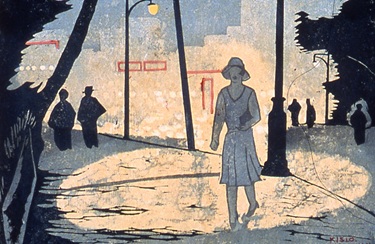
This online course shows the emergence of modern Tokyo through artist renderings of its neighborhoods, daily life and nightlife, nested between its recurring destruction by natural disasters and war. You will learn about the tradition of the “100 views,” and through these composite depictions of the city, witness the excitement and loss of change. Kiyochika Kobayashi’s woodblock prints of Tokyo in the late 1870s convey a moody view on the cusp of change as the new capital, formerly Edo, begins modernization with Western influences. Koizumi Kishio’s depictions of the “Imperial Capital” in the 1930s show the lively cosmopolitanism and move toward ultranationalism that placed the emperor at its center.
This course invites learners into the process of exploring history through content that literally looks at change in Tokyo over time. Learners will acquire background and skills that will help with:
None


Ellen Sebring, media artist and theorist, was a Research Fellow at MIT’s Center for Advanced Visual Studies, and the founding Creative Director of the MIT Visualizing Cultures project, with new units in projection in 2020, and a postdoctoral fellow at Duke University (2017-2018). Her book, Centerbook: the Center for Advanced Visual Studies and the Evolution of Art-Science-Technology at MIT , was released fall 2019. Sebring's immersive reality applications enhance visual access to history, focused on the Boxer Uprising in China, 1900.
Miyagawa has been involved with many aspects of digital learning at MIT. He was Senior Associate Dean for Open Learning, 2018 - 2021. He served on the original MIT committee that proposed OpenCourseWare, and was the Chair of the MIT OpenCourseWare Faculty Advisory Committee, 2010 - 2013. He is also Co-director of Visualizing Cultures with John Dower. With Andrew Gordon of Harvard, Gennifer Weisenfeld of Duke, and Professor Dower, he created Visualizing Japan, a Harvard-MIT MOOC offered by edX that has attracted over 20,000 learners world-wide.
He is also the producer of the multimedia program, StarFestival, which stars George Takei as the voice of the main character. StarFestival was awarded the Distinguished Award at the Multimedia Grandprix 2000 (Japan). During 2014 - 2019, he served as Project Professor and Director of Online Education for the University of Tokyo as a joint appointment with MIT. Since 2019, he has served as an external board member for Cyber University of the SoftBank Group. In April 2022, he was appointed as Executive Advisor to the Seikei University Society 5.0 Research Center.
John Dower, emeritus professor of Japanese history, retired from the History faculty in 2010 but remains active in MIT Visualizing Cultures: a pioneering website he co-founded with Professor Shigeru Miyagawa in 2002 that breaks new ground in the scholarly use of visual materials to reexamine the experience of Japan and China in the modern world. As of 2024, eleven of the lengthy presentations on this multi-unit site were authored by him.
Books by Professor Dower include Embracing Defeat: Japan in the Wake of World War II (1999); Cultures of War: Pearl Harbor/Hiroshima/9-11/Iraq (2010); and Ways of Forgetting, Ways of Remembering: Japan in the Modern World (2012). Awards for Embracing Defeat include the Pulitzer Prize (for general nonfiction), National Book Award (for nonfiction), and Bancroft Prize (for U.S. hisotry). Professor Dower also was executive producer of a documentary titled Hellfire—A Journey from Hiroshima that was a finalist for an academy award in 1988.
President, United States – Japan Foundation; former Senior Curator, Freer-Sackler Gallery, Smithsonian Institution. Ulak has curated multiple exhibitions and published as an art historian
Associate Professor of History, Massachusetts Institute of Technology; author of Tokyo Boogie-Woogie: Japan's Pop Era and Its Discontents (Harvard University Press, 2017)