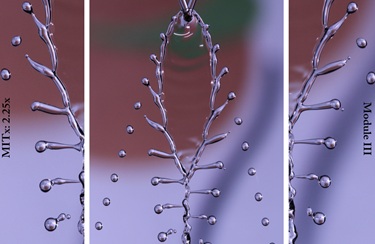
In this graduate-level online course from the MIT Department of Mechanical Engineering, you will learn how to apply key concepts in advanced fluid mechanics to better understand and solve real-world engineering problems.
The final module in a three-course sequence covering incompressible fluid mechanics, this course focuses on high Reynolds number flows and potential flow theory. You will also learn about the generation of vorticity in viscous boundary layers, connections between circulation and lift, generation of drag in the boundary layer, geometric effects in flow separation, and transition to turbulence. A separate final short module briefly introduces the role of surface tension in engineering fluid mechanics. This course features lecture and demo videos, lecture concept checks, practice problems, and extensive problem sets.
Based on material from 2.25 Advanced Fluid Mechanics -- one of the most popular first-year graduate classes in MIT’s Mechanical Engineering Department -- this series consists of the following three modules:
- Advanced Fluid Mechanics 1: Fundamentals
- Advanced Fluid Mechanics 2: The Navier-Stokes Equations for Viscous Flows
- Advanced Fluid Mechanics 3: Potential Flows, Lift, Circulation & Boundary Layer
Through lecture and demo videos, lecture concept checks, practice problems, and extensive problem sets, this series is designed to help you gain the ability to apply the governing equations, the principles of dimensional analysis and scaling theory to develop physically-based, approximate models of complex fluid physics phenomena.
Learners who complete these three consecutive courses will be able to apply their knowledge to analyze and break down complex problems they may encounter in industrial and academic research settings.
The material is of relevance to engineers and scientists across a wide range of mechanical, chemical and process industries who must understand, analyze and optimize flow processes and fluids handling problems. Applications are drawn from hydraulics, aero and hydrodynamics as well as the chemical process industries.